
Cape May County Court Records After a Jail Arrest
The local arrest-to-court path starts with custody, but it does not end there. If a person is committed to the Cape May County Correctional Center, Jail Records checks warrants and maintains booking, charge, bail, and court-transaction information for current inmates. The roster can identify the arrest event, while formal court records after that arrest are handled through New Jersey court systems.
New Jersey uses county prosecutors rather than district attorneys. In Cape May County, Prosecutor Jeffrey H. Sutherland and the Cape May County Prosecutor's Office screen indictable criminal matters arising from county arrests. Prosecutor action determines whether the case moves by indictment, accusation, amendment, downgrading, dismissal, plea, trial, or sentence. Sheriff Robert A. Nolan's office operates the correctional center, so jail custody and court prosecution are separate records tracks. For custody and booking identifiers, use Cape May County jail inmate records. For booking-photo limits, use Cape May County jail roster mugshots.
From Arrest and Booking to Court Records
A Cape May County arrest can begin with a local police charge, warrant, bench warrant, or detainer. If the person is booked into the correctional center, the roster's charge field reflects the original charge as it appears on charging documents from the committing authority.
After jail commitment, New Jersey Criminal Justice Reform materials describe a prompt first appearance and pretrial review, often within 24 to 48 hours. A judge and pretrial services address release, conditions, or detention. Then prosecutor review becomes critical: a roster charge can be amended, screened out, downgraded, or replaced by a formal court filing. Indictable offenses move through Superior Court, while disorderly persons and petty disorderly persons matters are usually municipal-court matters unless tied to an indictable case.
How to Search Court Records After a Cape May County Arrest
The statewide public search point for Superior Court criminal matters is NJ Courts PROMIS/Gavel Public Access. Use the jail roster or Jail Records for current custody. Use PROMIS/Gavel to see what formal criminal case exists after the arrest and how the court charges are moving.
- Open PROMIS/Gavel Public Access and choose one search type instead of mixing unrelated fields.
- Search by defendant name using last name, first name, and middle initial when available, or search by indictment or accusation number if known.
- Open the matching case and compare the defendant, county, docket or indictment information, and charge list.
NJ Courts warns that some records are not available for public inspection, including juvenile cases, expunged cases, probation records, and certain confidential categories. A missing result may mean the case is restricted, municipal rather than Superior Court, too old for the visible portal result, or not indexed by the information entered.
The official PROMIS/Gavel page captured in the project image manifest is the relevant state search screen for this court-record task. Source: NJ Courts PROMIS/Gavel Public Access entry page.
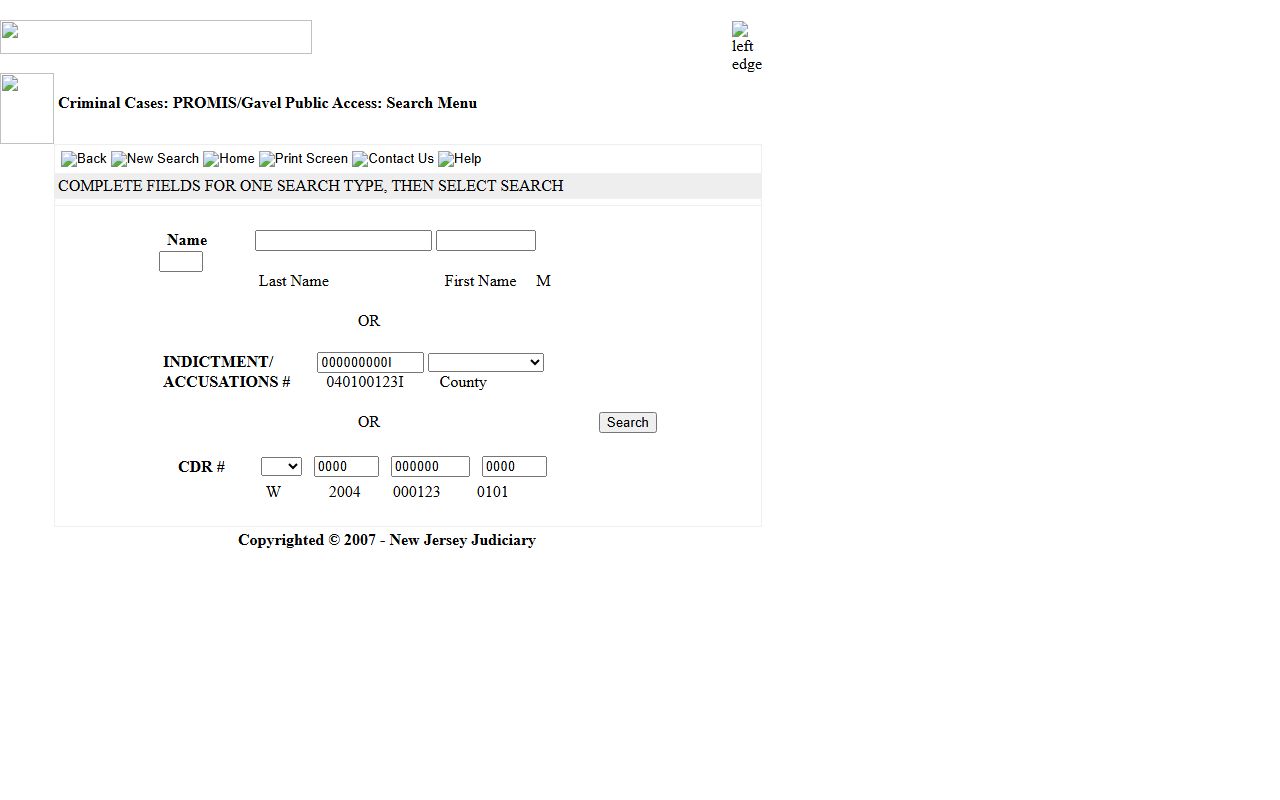
The image shows the search workflow is court-centered, not jail-centered. A Cape May County booking can help identify the person, but the case lookup has its own fields and restrictions.
PROMIS/Gavel Search Fields for Court Records After Arrest
Use the most specific information available from the jail roster, court notice, or charging paperwork. PROMIS/Gavel instructs users to complete fields for one search type and then select search.
| Field Label | Type | Required | How to Use It |
|---|---|---|---|
| Name - Last Name | Text | Required for name search | Enter the defendant's last name as it may appear in court records. |
| Name - First Name | Text | Usually paired with last name | Add the first name to narrow Cape May County results. |
| Name - M. | Text | Optional | Use the middle initial when known from jail or court paperwork. |
| Indictment/Accusation | Text | Required for number search | Use when the indictment or accusation number is known. |
| Select Search | Button | Not applicable | Submit after completing one search type, consistent with the portal instruction. |
Charging Documents After an Arrest
The first jail listing may show the original committing-authority charge. Later court records may show a complaint, accusation, indictment, amended count, downgraded charge, dismissal, plea, or sentence. Cape May County's legal definitions also distinguish indictable charges, disorderly persons offenses, grand jury action, and offense degree.
| Document Type | Who Uses It | Common Role | What to Compare |
|---|---|---|---|
| Complaint | Law enforcement or prosecutor | Initial charging document connected to the arrest or warrant | Compare with the jail roster's original charge and committing authority. |
| Accusation | Prosecutor | Formal prosecutor-filed charge route when applicable | Use the accusation number in PROMIS/Gavel if known. |
| Indictment | Grand jury and prosecutor | Formal Superior Court charging document for indictable matters | Check whether counts differ from the booking charge wording. |
| Municipal complaint or summons | Municipal court or issuing agency | Lower-level disorderly persons or petty disorderly persons matters | May not appear the same way as Superior Court PROMIS/Gavel results. |
Charge Status in Court Records After Arrest
Charge status often changes after booking. The county roster says charges are removed from the website when satisfied by bail, court order, or sentence completion on the next update. That removal is not the same thing as a court dismissal.
| Status | What It Means | Where to Verify |
|---|---|---|
| Pending | The charge remains active and has not reached final disposition. | PROMIS/Gavel, court notices, or the court division office. |
| Amended | The charge wording, count, degree, or statutory basis changed after filing. | Case docket entries and filed charging documents. |
| Downgraded or Reduced | The prosecutor or court process moved the matter to a lower charge level. | Court docket, plea documents, or municipal/Superior Court records. |
| Dismissed | The charge was not carried forward to conviction, though records may still exist unless sealed or expunged. | Court disposition and copy request procedures. |
| Detainer or Outside Hold | An outside agency or jurisdiction has a related hold or charge. | Cape May County Jail Records at 609-465-1233 and the issuing agency. |
First Appearance, Bail, and Release After an Arrest
Bail and release status affect whether a person remains in custody while court records develop. Cape May County says the roster's Bail Amount column shows current bail status, but the site should not be relied on before posting bail because it updates daily. Call Jail Records at 609-465-1233 before payment or release planning.
County legal definitions explain bail as security to ensure court appearance and release-condition compliance. Accepted forms include bail bond, certified bank check, money order, and exact-change cash. Credit cards and personal checks are not accepted. For indictable-charge bail, the research notes a $50 non-refundable State of New Jersey fee not reflected in the displayed bail amount.
| Release or Payment Type | How It Works Locally |
|---|---|
| Cash bail | Exact-change cash may be accepted and deposited into a drop safe, subject to current Jail Records confirmation. |
| Certified bank check or money order | Accepted local payment forms for bail or qualifying court conditions. |
| Bail bond | A bond agent may post security and typically charges a nonrefundable fee for services. |
| Condition of release | A court order may require a specific action or monetary condition that is not the same as refundable bail. |
| No-bail or hold situation | A $0.00 roster amount may mean bail is pending, a no-bail warrant requires court appearance, a sentence exists, or another hold blocks release. |
Warrants That Lead to Court Records After Arrest
No official Cape May County online public active-warrant search was located in the research. Jail Records checks for outstanding warrants when an inmate enters the correctional center and before release, and the roster may show a committing authority, detainer, detainer amount, or bail status after a warrant results in custody. Use official channels rather than third-party warrant sites: call Jail Records at 609-465-1233 for current custody, bail, release, and detainer questions, or confirm court warrants with the issuing court or case record.
Charges vs. Convictions in Court Records
An arrest charge is not a conviction. A person can be booked, appear on the jail roster, and have a court case without being found guilty. Read Cape May County court records after an arrest by stage, not as a single final label.
| Charge | Conviction | |
|---|---|---|
| Stage | Accusation, complaint, accusation, indictment, or amended count | Final outcome after plea, verdict, or qualifying disposition |
| Meaning | Alleged conduct filed by an officer, prosecutor, or grand jury process | Legal finding or plea that resolves guilt on the offense |
| Can Change | Yes, charges can be amended, downgraded, dismissed, or replaced | Changes usually require court action, appeal, post-conviction relief, or expungement where eligible |
| Lookup Channel | Jail roster for original custody charge, PROMIS/Gavel for court charge | Court disposition, sentencing record, or certified court copy |
Sealed vs. Expunged Arrest Records and Court Records
New Jersey public access is shaped by OPRA, court rules, and expungement law. OPRA generally provides access to government records unless an exemption applies, but criminal investigatory, juvenile, confidential, expunged, security, and privacy-protected information can be withheld. NJ Courts says eligible people can apply for expungement through the free eCourts Expungement System.
| Sealed or Restricted | Expunged | |
|---|---|---|
| Public Visibility | Hidden or limited under court rule, statute, or confidentiality category | Removed from ordinary public access after a qualifying expungement order |
| Record Still Exists | Often yes, but access is restricted | Handled under New Jersey expungement law and court order terms |
| Common Examples | Juvenile, probation, confidential, security, or certain investigatory records | Eligible dismissed or resolved criminal matters under N.J.S.A. 2C:52-1 et seq. |
| Where to Start | NJ Courts record access or the relevant records custodian | NJ Courts expungement information |
Records Copies, Prosecutor OPRA, and Jail OPRA Fallback
For court-file copies, certified documents, or older files not visible online, use NJ Courts copy procedures through the Superior Court Clerk's Office or the correct division office. For prosecutor-office records subject to OPRA, use the Cape May County Prosecutor OPRA resource page. For county custody records, older jail records, or records not displayed online, use Cape May County Government Records.
The county OPRA page routes requesters to the Request For Access To Government Records Form and identifies Donna Doyle, Deputy Clerk of the Board, at 4 Moore Road, Cape May Court House, NJ 08210. The Sheriff's records page at Cape May County Sheriff's Office Records gives a separate email route for Sheriff's incident or accident reports: Records@cmcsheriff.net. Other requests go through OPRA under N.J.S.A. 47:1A-1.
Background Check Limits for Court Records After Arrest
Public case searches and jail lookups are not regulated background checks. A court record after arrest may be incomplete, pending, restricted, amended, or later expunged.
Important: This site is not a consumer reporting agency and is not for FCRA-covered screening decisions.
Restricted Court Records After an Arrest in Cape May County
Some court records after an arrest will not be available through public search. NJ Courts warns that juvenile matters, expunged cases, probation records, and other confidential categories may be closed. OPRA also recognizes exemptions for criminal investigatory records and other protected materials. If a record is not found in PROMIS/Gavel, confirm spelling, search type, court level, and county, then use court copy procedures, prosecutor OPRA, county OPRA, or the issuing court.